How Does AI Work? Explained in Simple Words
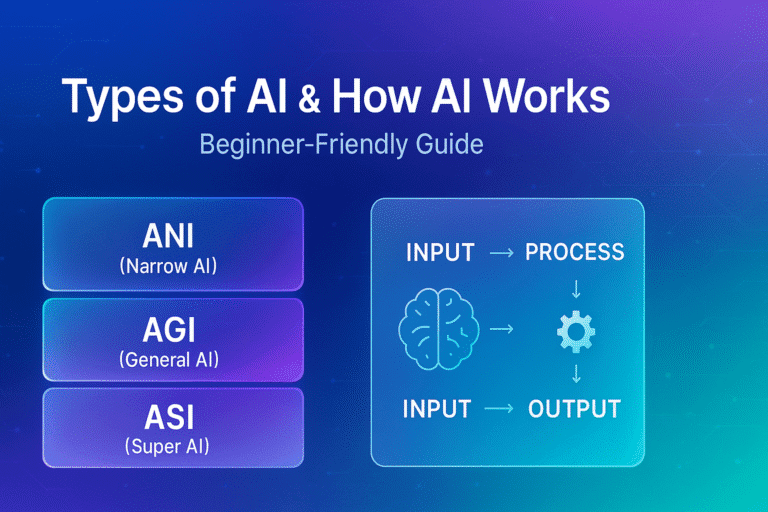
Artificial Intelligence may sound complicated, but the basic idea is easy to understand. AI learns from examples, finds patterns, and uses those patterns to answer questions or make decisions. You do not need technical language to understand the fundamentals. This lesson explains how AI works in clear and simple terms, especially for beginners and students.
What Does AI Learn From?
AI learns from data. Data means information, examples, text, images, videos, or anything humans create or record.
Examples of data AI learns from:
- Books and articles
- Websites
- Images and videos
- Code and formulas
- Conversations and text examples
The more examples AI sees, the better it gets at recognizing patterns.
AI Learns by Finding Patterns
AI does not understand like humans.
It does not think or feel.
Instead, it looks for patterns.
Example:
If AI sees thousands of photos of cats and dogs, it starts noticing things like:
Cats usually have pointy ears
Dogs usually have longer snouts
AI does not know what a cat is.
It simply recognizes patterns.
How Does AI Answer Questions?
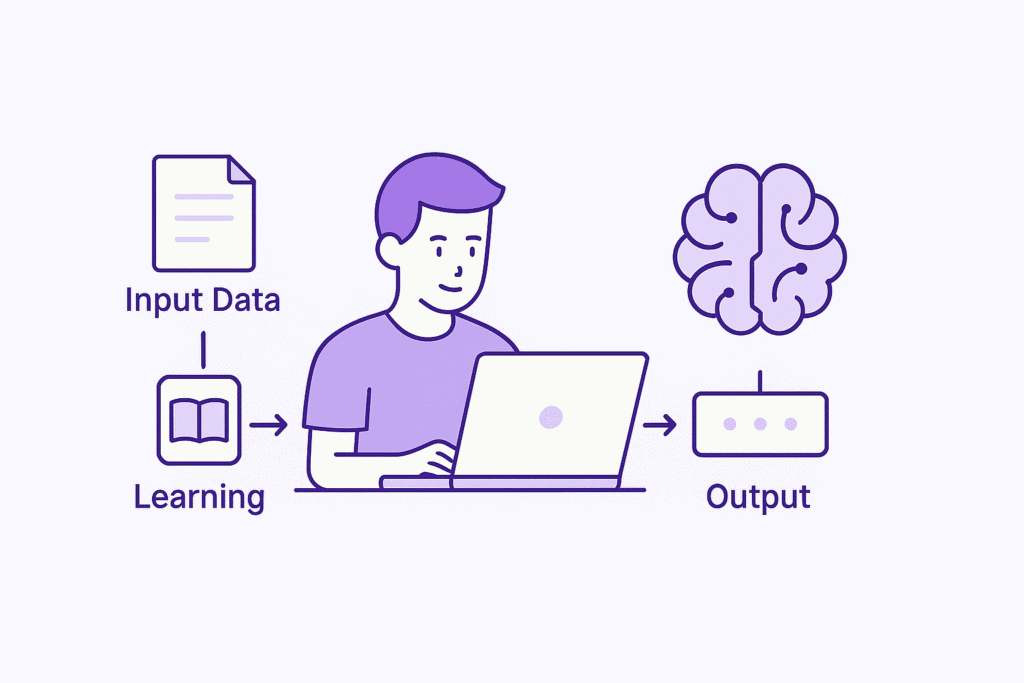
When you ask a question, the system searches for the most accurate pattern match based on what it has learned before.
Example:
You ask:
Explain photosynthesis
AI checks its training patterns and produces an answer based on similar examples it has seen in the past.
It does not recall exact sentences.
It predicts the answer word-by-word using probability.
That is why AI can create new sentences instead of copying old ones.
AI Improves Through Training
AI does not learn instantly.
It gets trained over time using large collections of data.
Training means showing AI millions or billions of examples until it becomes good at predicting answers.
More data + better training = smarter AI.
AI Makes Mistakes
Because AI predicts answers, not understands them, it can make errors.
It may:
- Misunderstand a question
- Provide incorrect facts
- Fill gaps with guesses
This is normal.
Always double-check important results.
Types of Learning in Simple Words
There are different types of AI learning. Here are plain-language explanations:
Learning from examples:
AI is shown examples and learns patterns (like learning from flashcards)
Learning without examples:
AI studies information and finds patterns by itself
Learning from feedback:
AI gets rewarded for correct answers and improves with practice
Real-World Example
Think of AI like a student learning math:
First, the student sees many solved examples
Then they try solving problems
With feedback, they improve over time
AI works the same way: observe → practice → improve
Why Is This Important for You?
Understanding how AI works helps you:
- Use AI responsibly
- Ask better questions
- Correct mistakes
- Apply AI for studying or work
- Build confidence in learning technology
You do not need to know how to build AI to benefit from it.
You just need to understand how to use it wisely.
Summary
AI works by learning from examples, identifying patterns, and predicting answers. It does not truly understand like humans, but it becomes useful through training. With practice and good prompts, beginners and students can use AI effectively for learning and productivity.
Student Practice
Try the following tasks:
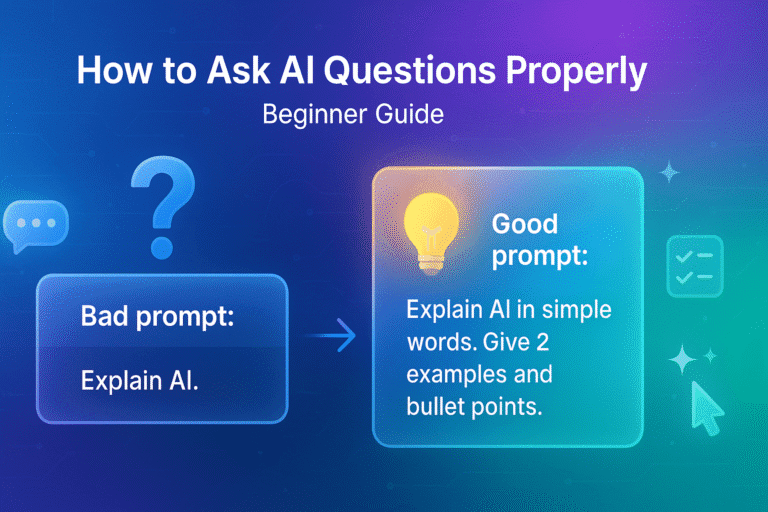
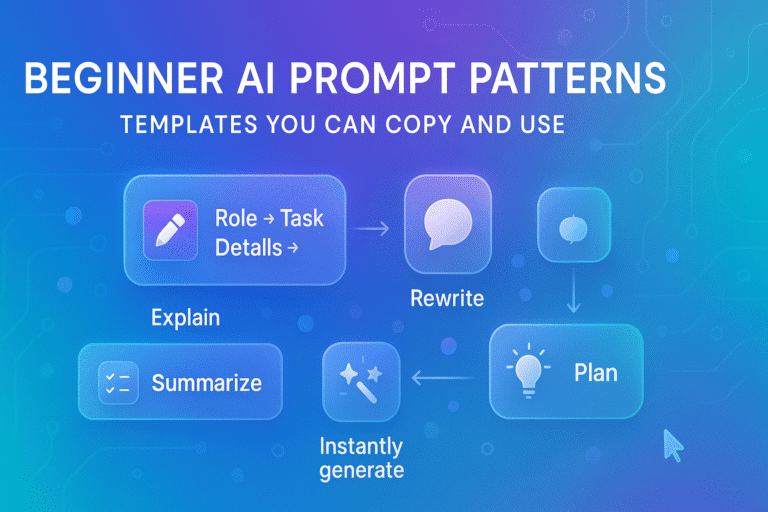
- Ask an AI tool to explain gravity in simple words, then ask for a version for a 10-year-old. Compare the answers.
- Give AI a paragraph from your textbook and ask it to summarize it in three sentences.
- Ask: “Explain how you learn in simple words,” and read the response.
Observe how the answers change based on the prompt.